Cap Ground Team Task Guide: A Comprehensive Overview (Updated 05/05/2026)
This guide, updated today, 05/05/2026, details essential procedures for Civil Air Patrol ground teams, encompassing tasks from initial emergency response to advanced urban direction finding techniques.
The Cap Ground Team Task Guide serves as a foundational document for all Civil Air Patrol (CAP) members involved in search and rescue (SAR) operations on the ground. This comprehensive resource, continually updated – most recently on May 5th, 2026 – provides a standardized framework for training, procedures, and operational effectiveness.
It’s designed to bridge the gap between foundational CAP training and the practical realities of field deployments. The guide isn’t merely a collection of instructions; it’s a dynamic tool reflecting best practices and lessons learned from real-world SAR missions.
Understanding the contents of this guide is paramount for ensuring mission success and, most importantly, the safety of both the team members and those they are tasked to locate. As highlighted in online discussions, each chapter focuses on specific tasks, building a robust skillset for CAP ground teams.
What is the Ground Team Task Guide?
The Ground Team Task Guide is a detailed reference document outlining the specific procedures and expectations for Civil Air Patrol (CAP) ground team members during search and rescue (SAR) incidents. It’s structured around a chapter-based system, with each chapter dedicated to a critical aspect of ground team operations.
Unlike a general handbook, the Task Guide focuses on tasks – discrete, actionable steps required to perform effectively in the field. As noted in recent online forums, each “item” within the guide corresponds to one or more specific tasks detailed within its chapters.
For example, Chapter 1, titled “SAR IS AN EMERGENCY,” outlines the initial response protocols. The guide isn’t simply a list; it’s a framework for consistent, safe, and effective SAR operations, ensuring all team members operate from the same foundational understanding. It’s a vital tool for preparedness.
Purpose and Scope of the Guide
The primary purpose of the Cap Ground Team Task Guide is to standardize training and operational procedures for all CAP ground team members involved in emergency services. It aims to ensure a consistent and effective response to search and rescue missions, minimizing risks and maximizing the probability of successful outcomes.
The scope of the guide encompasses all phases of a typical SAR operation, beginning with initial notification and proceeding through active searching, potential find procedures, and incident closeout. It specifically addresses pre-qualifications, like completing FEMA IS-700, a foundational course in the National Incident Management System (NIMS).
Furthermore, the guide extends to specialized teams, such as Urban Direction Finding (UDF) teams, outlining their unique tasks and coordination requirements. It serves as a crucial resource for both new and experienced members, promoting competency and adherence to best practices.
Essential Pre-Qualifications for Ground Team Members
Ground team members must complete FEMA IS-700, emergency services training at the First Responder Level, and maintain current Basic First Aid/CPR/AED certification.
FEMA IS-700: National Incident Management System (NIMS)
FEMA’s IS-700 course is a foundational requirement for all Civil Air Patrol ground team members, providing a critical orientation to the National Incident Management System (NIMS). This entirely online course establishes a standardized approach to incident management across various organizations, ensuring effective collaboration during emergencies.
Understanding NIMS is paramount for seamless integration with other responding agencies, like FEMA and local emergency services. The course covers key concepts such as incident command, resource management, and communication protocols. Successful completion demonstrates a commitment to standardized procedures, enhancing overall operational efficiency and safety.
Access to IS-700 is readily available through the FEMA Training website (https://training.fema.gov). It’s a self-paced course, allowing flexibility for team members to complete it at their convenience. This pre-qualification step is vital for effective participation in search and rescue operations.
Emergency Services Training – First Responder Level
First Responder level training is a crucial pre-qualification for Cap Ground Team members, equipping them with essential skills to provide immediate assistance in emergency situations. This training focuses on recognizing and responding to a wide range of medical and trauma scenarios encountered during search and rescue operations.
The curriculum covers vital areas such as patient assessment, basic life support, wound care, splinting, and moving injured individuals. Participants learn to effectively manage the scene, ensuring their own safety and the well-being of the casualty. This foundational knowledge builds confidence and competence in providing initial care.
Successful completion of a recognized First Responder course demonstrates a commitment to providing effective emergency assistance. It’s a prerequisite for further advanced medical training within the Civil Air Patrol, enhancing the team’s overall capabilities and readiness to respond to diverse incidents.
Basic First Aid/CPR/AED Certification
Possessing current Basic First Aid, Cardiopulmonary Resuscitation (CPR), and Automated External Defibrillator (AED) certification is non-negotiable for all Cap Ground Team members. These skills are fundamental in stabilizing patients experiencing life-threatening emergencies until advanced medical personnel arrive on scene.
Certification courses provide hands-on training in recognizing cardiac arrest, performing high-quality CPR compressions, delivering effective rescue breaths, and operating an AED safely and efficiently. First aid training covers managing bleeding, burns, fractures, and other common injuries encountered during search and rescue missions.
Regular recertification is mandatory to maintain proficiency and stay updated on the latest guidelines and techniques. This commitment ensures that Ground Team members are prepared to provide immediate, life-saving interventions, significantly increasing the chances of positive outcomes in critical situations.
Key Chapters and Tasks within the Guide
The guide is structured into chapters, each detailing specific tasks – from initial emergency responses (Chapter 1) to team organization and advanced navigation techniques.
Chapter 1: SAR is an Emergency – Initial Response Procedures
This foundational chapter emphasizes the critical, time-sensitive nature of Search and Rescue (SAR) operations. It outlines the immediate actions required upon notification of a missing person, stressing rapid assessment and initial response protocols. Ground teams must prioritize establishing a preliminary incident command post and initiating communication with relevant authorities, including local law enforcement and the National Incident Management System (NIMS) structure.
Key procedures covered include initial scene assessment, gathering crucial information about the missing person (last known location, physical description, medical conditions), and implementing basic search strategies. The chapter details the importance of securing the scene to preserve potential evidence and ensuring the safety of both the search team and the potential subject. Furthermore, it highlights the necessity of documenting all actions and observations meticulously, adhering to ICS guidelines for accurate record-keeping and effective communication throughout the operation.
Understanding that SAR is an emergency dictates a proactive and decisive approach, demanding swift implementation of established protocols and a commitment to maximizing the chances of a successful outcome.
Chapter 2: Team Organization and Roles

Effective SAR operations hinge on a clearly defined team structure and well-understood roles. This chapter details the organizational framework for a typical CAP ground team, emphasizing the importance of the Incident Command System (ICS) integration. Key positions, such as Team Leader, Navigator, Communications Officer, and Search Technicians, are thoroughly described, outlining their specific responsibilities and reporting relationships.
The chapter stresses the need for a designated safety officer responsible for risk assessment and mitigation throughout the operation. It also covers the concept of task assignment, ensuring each team member has a defined role and understands their contribution to the overall mission. Effective communication protocols are paramount, with emphasis on clear and concise messaging between team members and with incident command.
Understanding individual roles and the team’s overall structure fosters collaboration, efficiency, and ultimately, a higher probability of a successful search and rescue outcome. Proper organization is fundamental to safe and effective operations.
Chapter 3: Navigation and Map Reading
Proficiency in navigation and map reading is critical for ground team members operating in diverse terrains. This chapter provides a comprehensive overview of essential skills, beginning with topographic map interpretation – understanding contour lines, elevation, and terrain features. It details the use of compasses, including declination adjustment and bearing calculations, vital for accurate direction finding.
The chapter also covers practical techniques like triangulation and resection, enabling teams to pinpoint their location and navigate to designated points. Emphasis is placed on utilizing GPS devices as a supplementary tool, acknowledging their limitations and the importance of maintaining traditional map reading skills.
Route planning, pacing, and distance estimation are also addressed, ensuring teams can efficiently cover search areas. Practical exercises and real-world scenarios are encouraged to reinforce learning and build confidence in navigating challenging environments.

Ground Team Member Responsibilities
Ground team members execute search techniques, integrate within the Incident Command System, and maintain clear communication using designated protocols and specialized equipment for effective missions.
Search Techniques: Linear, Parallel, and Expanding Square
Effective search patterns are crucial for locating individuals in need of assistance. Linear search involves teams moving in a straight line, covering ground systematically. This is best suited for trails or defined areas. Parallel search utilizes multiple teams moving in adjacent lines, maximizing coverage in larger, open terrains.
The expanding square technique begins with a small search area and progressively increases its size, ideal when the last known position is established. Teams must maintain consistent spacing and communication throughout each pattern. Proper technique ensures thoroughness and minimizes the risk of overlooking potential clues or the subject.
Understanding terrain and visibility are paramount when selecting and implementing these methods. Adapting the chosen technique to the specific environment significantly increases the probability of a successful search and rescue operation. Regular training and practice are essential for proficiency.
Incident Command System (ICS) Integration
Effective integration with the Incident Command System (ICS) is paramount for successful search and rescue operations. Ground teams must understand their roles within the larger ICS structure, reporting to designated Incident Commanders and adhering to established protocols. This includes utilizing standardized terminology and communication channels.
FEMA’s IS-700 course provides foundational knowledge of NIMS and ICS principles, a pre-qualification for ground team members. Clear communication of search progress, findings, and resource needs is vital. Teams should be prepared to receive task assignments and adapt to changing incident conditions as directed by command.
Proper ICS integration ensures a coordinated and efficient response, minimizing duplication of effort and maximizing resource utilization. Maintaining situational awareness and adhering to the chain of command are critical for safety and mission success.
Communication Protocols and Equipment
Reliable communication is the lifeline of any ground team operation. Standardized protocols are essential for clear and concise information exchange between team members, command, and other responding agencies. This includes utilizing pre-defined radio frequencies and call signs.
Ground teams must be proficient in operating assigned communication equipment, including handheld radios, and potentially satellite communication devices. Regular equipment checks and maintenance are crucial to ensure functionality. Understanding signal propagation and potential interference sources is also important.
Adherence to established communication disciplines, such as brevity codes and clear voice transmission, minimizes errors and maximizes efficiency. Maintaining communication security and protecting sensitive information are paramount considerations during operations.
Understanding UDF (Urban Direction Finding) Teams
UDF teams specialize in locating electronic signals in complex urban environments, requiring unique skills and equipment to effectively coordinate with traditional ground teams.
UDF Team Specific Tasks and Equipment
UDF teams undertake specialized tasks centered around locating Emergency Locator Transmitters (ELTs) and other electronic signals within urban canyons and challenging terrain. These tasks differ significantly from standard ground search procedures, demanding a focused skillset.
Essential equipment includes specialized radio direction-finding antennas, receivers capable of detecting weak signals, and sophisticated signal analysis software. Teams must also carry detailed urban maps, GPS devices, and robust communication systems to maintain contact with Incident Command and coordinating ground teams.
Furthermore, UDF personnel require training in signal propagation characteristics in urban environments, interference mitigation techniques, and the proper use of direction-finding equipment. Understanding how buildings and infrastructure affect signal strength is crucial for accurate location determination. Regular equipment calibration and proficiency drills are also paramount to ensure operational readiness and effective search capabilities.
Coordination Between Ground and UDF Teams
Effective coordination between ground teams and Urban Direction Finding (UDF) teams is vital for successful search and rescue operations. This synergy requires clear communication protocols and a shared understanding of each team’s capabilities and limitations.
Ground teams provide UDF teams with initial search area boundaries, terrain information, and potential signal interference sources. Conversely, UDF teams relay signal direction and estimated distance to the source, guiding ground teams towards the target location.
Regular communication checks, utilizing a common radio frequency, are essential; Incident Command plays a crucial role in facilitating this information flow and ensuring both teams operate with a unified strategy. Pre-mission briefings should clearly define roles, responsibilities, and contingency plans. Successful missions depend on seamless integration and collaborative problem-solving between these specialized units.
Advanced UDF Techniques
Beyond basic signal acquisition, advanced Urban Direction Finding (UDF) techniques significantly enhance search capabilities. These include utilizing signal triangulation from multiple UDF teams to pinpoint a more precise location, minimizing the search area for ground personnel.
Frequency scanning and analysis are crucial for identifying weak or intermittent signals, often emitted from devices with low battery power. Understanding signal propagation characteristics within urban environments – considering building materials and interference – is also key.
Employing specialized software and antenna configurations can improve signal clarity and directionality. Training emphasizes interpreting signal strength indicators and compensating for environmental factors. Continuous practice and refinement of these techniques are essential for maximizing UDF effectiveness in complex search scenarios, ultimately leading to faster and more successful rescues.

Safety Considerations for Ground Teams
Prioritizing team safety involves thorough risk assessment, utilizing appropriate Personal Protective Equipment (PPE), and establishing protocols for navigating hazardous environments during operations.
Risk Assessment and Mitigation
Effective risk assessment is paramount for ground team safety. Before any operation, a comprehensive evaluation of potential hazards must be conducted, considering environmental factors, terrain challenges, and potential threats encountered during search and rescue missions. This process involves identifying hazards, analyzing their likelihood and potential impact, and then developing mitigation strategies to minimize risks.
Mitigation strategies can include adjusting search patterns to avoid dangerous areas, utilizing appropriate Personal Protective Equipment (PPE) – such as helmets, gloves, and sturdy footwear – and implementing buddy systems to ensure mutual support and accountability. Constant monitoring of changing conditions is crucial, requiring teams to adapt their plans as needed.
Regular briefings and debriefings are essential for sharing information about identified risks and lessons learned. Teams should be trained to recognize and report hazards, and empowered to halt operations if conditions become unsafe. A proactive approach to risk management significantly enhances the safety and effectiveness of ground team operations.
Personal Protective Equipment (PPE) Requirements
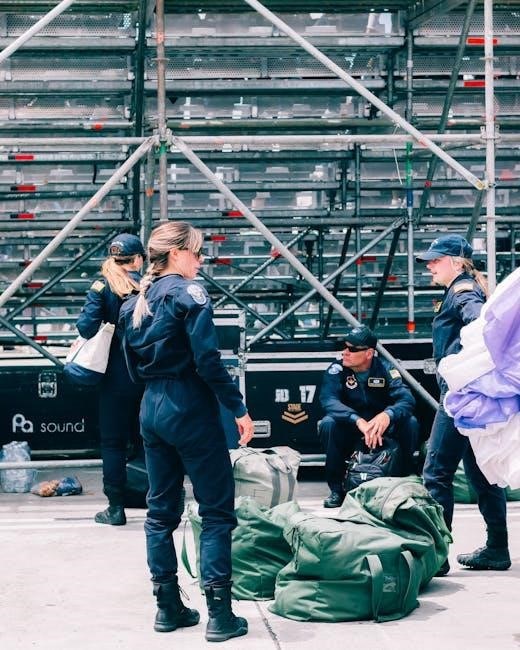
Mandatory PPE is crucial for safeguarding ground team members during diverse operational environments. At a minimum, all personnel must wear sturdy, over-the-ankle boots providing ankle support and protection from uneven terrain. Durable work gloves are essential for handling equipment and navigating through vegetation, preventing injuries to hands.
A high-visibility vest or jacket is required to ensure team members are easily seen, particularly in low-light conditions or near roadways. Depending on the specific mission, additional PPE may include helmets for head protection, eye protection (safety glasses or goggles), and appropriate clothing for weather conditions – including rain gear and thermal layers.
Teams must also carry appropriate insect repellent and sunscreen. Regular inspection of PPE is vital to ensure it remains in good working order. Proper training on the correct use and maintenance of all PPE is mandatory, reinforcing a culture of safety and preparedness within the ground team.
Dealing with Hazardous Environments
Ground teams may encounter various hazardous environments demanding strict adherence to safety protocols. These include unstable terrain, inclement weather, potential wildlife encounters, and exposure to hazardous materials. Prior to entering any potentially dangerous area, a thorough risk assessment must be conducted, identifying potential hazards and implementing mitigation strategies.
Teams must be trained to recognize and avoid dangerous situations, and to implement appropriate safety measures. This includes establishing clear communication protocols, maintaining situational awareness, and utilizing appropriate PPE. Awareness of hypothermia and hyperthermia risks is critical, alongside protocols for dealing with them.
If hazardous materials are suspected, teams should maintain a safe distance and immediately notify incident command. Never attempt to handle or investigate unknown substances. Regular safety briefings and debriefings are essential to reinforce safe practices and learn from experiences, ensuring team member wellbeing.